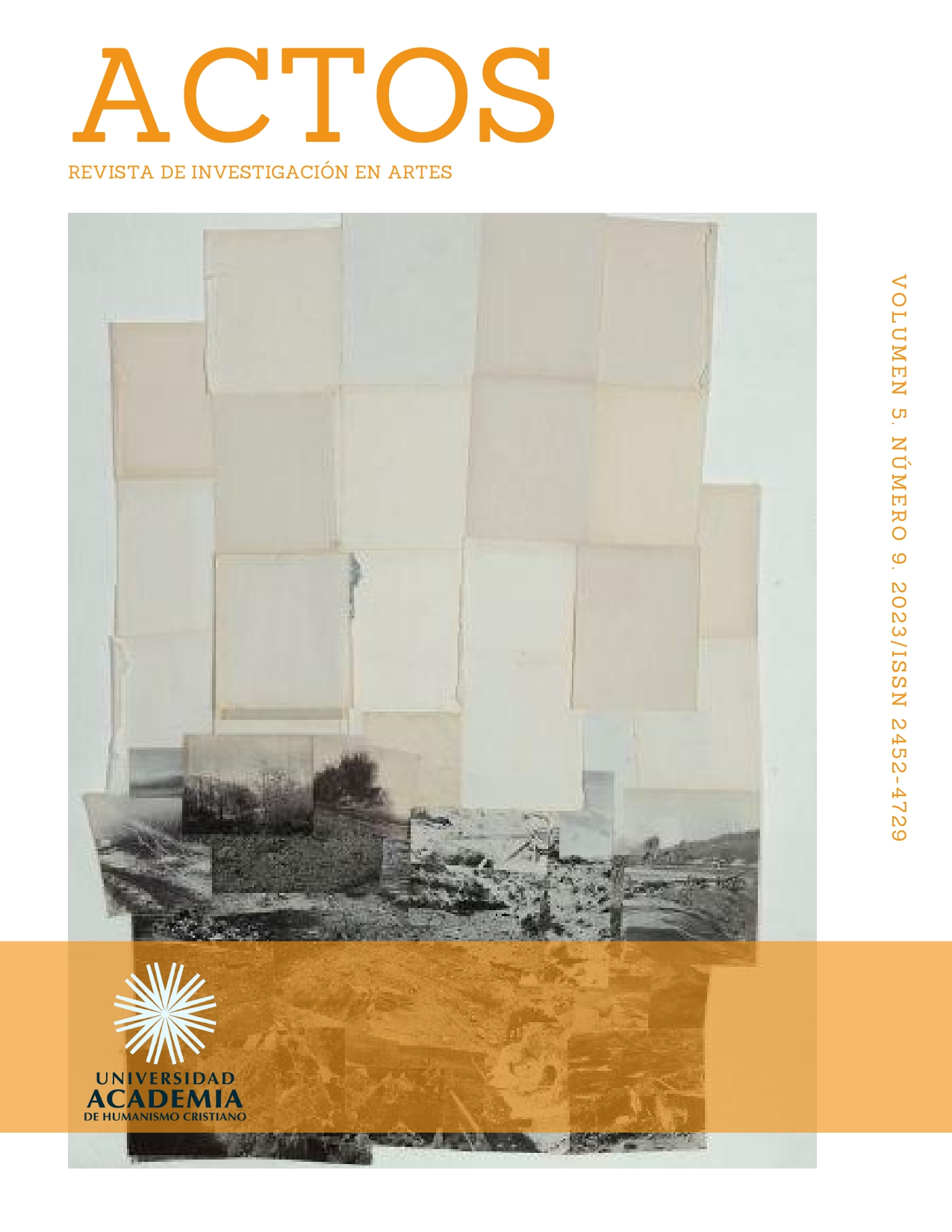
Ñamen, Desaparecer, venir en olvido (Danilo Espinoza, 2017): the family album and the fractures of the story
el álbum familiar y las fracturas del relato
DOI:
https://doi.org/10.25074/actos.v5i9.2368Keywords:
Danilo Espinoza, Joel Huaquiñir, Mapuche, Disappeared detainees, Family albumAbstract
The series Ñamen. Desaparecer, venir en olvido (2017), by visual artist Danilo Espinoza, explores the possibilities of photographic material to represent the memories of the violence exercised on the Mapuche people, using smoke as a technical resource in the developing process. The work interrogates the memories of the Mapuche people disappeared detainees during the Chilean dictatorship, revealing an extensive and dense plot of violence.
The present article explores the visual strategies proposed in this work, which stress the identity-cohesive narrative device of the family album, as well as the photographic device itself.
Thus, the reading we proposed, investigates, particularly, the treatment of time in this photographic practice, and the affectation of the gaze, from the smoked materiality of these images. According to this perspective, photography, in its (in)ability to refer to the real – which is expressed through the smoke that opaques and veils the image− constitutes the trace of Joel Huaiquiñir's existence. It is its blurred quality that allows us to account for his life and his death, for the density and continuity of the violence against the Mapuche people, and for the limitations and duplicities of the photographic device.
Downloads